

 wellnessfitpro
Despite a flurry of aggressive policy announcements from the White House aimed at unlocking the frozen U.S. housing market, strategists at Morgan Stanley argued this month that the measures won’t significantly alter the landscape for prospective homebuyers in 2026.
In a research note released on Jan. 18, strategists James Egan and Jay Bacow characterized President Trump’s recent directives as only “modestly helpful for homeowner affordability,” warning that they ultimately amount to a marginal adjustment rather than a market cure.
The centerpiece of the administration’s strategy involves a directive for government-sponsored enterprises (GSEs) Fannie Mae and Freddie Mac to purchase $200 billion in mortgage-backed securities (MBS). The immediate market reaction was positive, the bank noted, as mortgage spreads tightened by 15 basis points, pushing the 30-year mortgage rate below 6% for the first time since 2022.
However, Egan and Bacow wrote that they believe the market has already efficiently priced in Trump’s intervention. While acknowledging the drop in rates is directionally positive, they argued that the sheer volume of existing low-rate mortgages renders the policy less effective than hoped.
The ‘lock-in’ effect persists
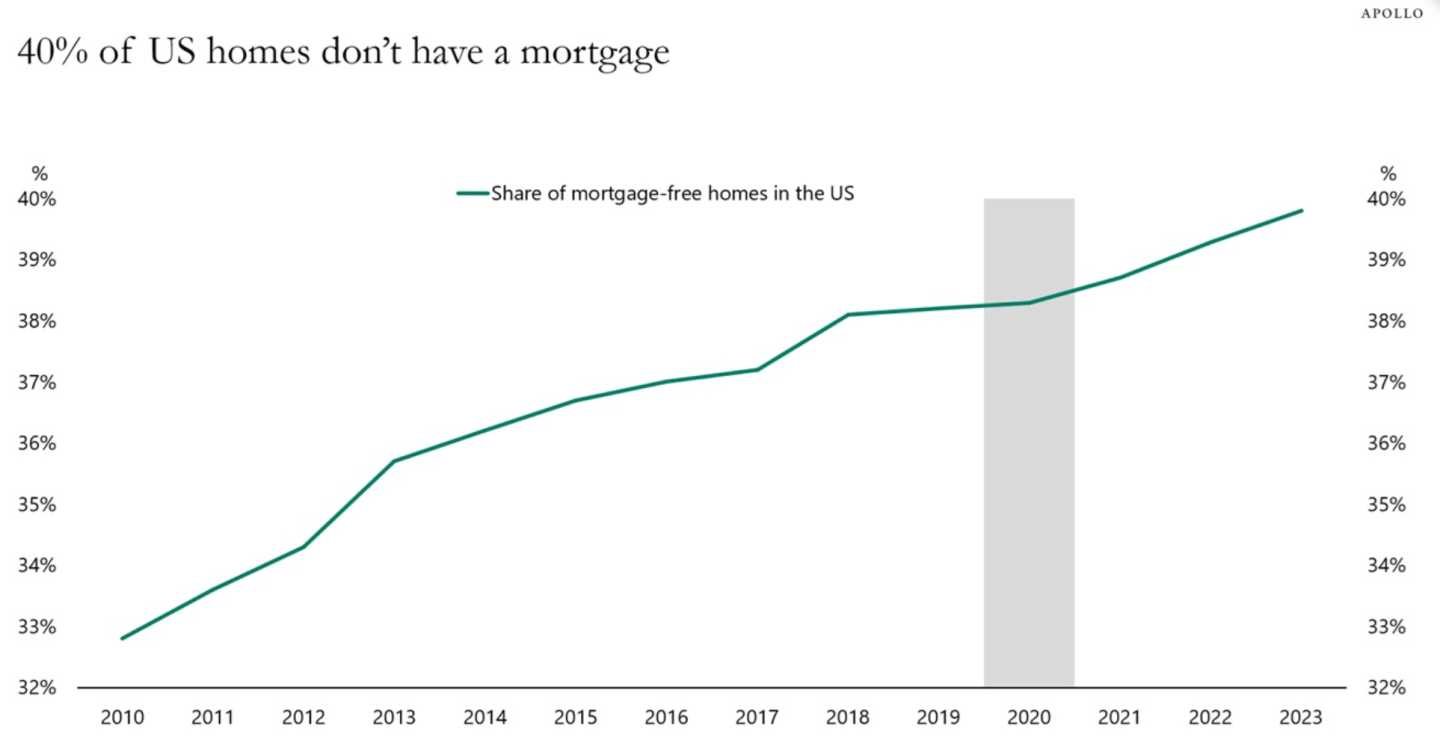
The primary obstacle preventing a housing market recovery remains the “lock-in” effect, with Morgan Stanley noting that roughly two-thirds of all outstanding mortgages still carry an interest rate below 5%. Apollo Global Management’s Torsten Slok, an influential and widely read Wall Street analyst, noted in early January that a whopping 40% of U.S. homes don’t have a mortgage, meaning the lock-in is even greater than what mortgage data indicates.
Angst about the frozen housing market manifests in the White House with Trump and his housing director, Bill Pulte, complaining that Federal Reserve Chair Jerome Powell is keeping interest rates too high, thereby keeping mortgage rates too high as well. At the ResiDay conference in November, Pulte called Powell “deranged” and a “maniac.”
At the generational level, it looks like household-formation-age millennials and increasingly 30-something-approaching Gen Zers are being boxed out of the market by boomers, who are downsizing in retirement to what would otherwise be a starter home or staying put in larger homes that families adding more kids need.
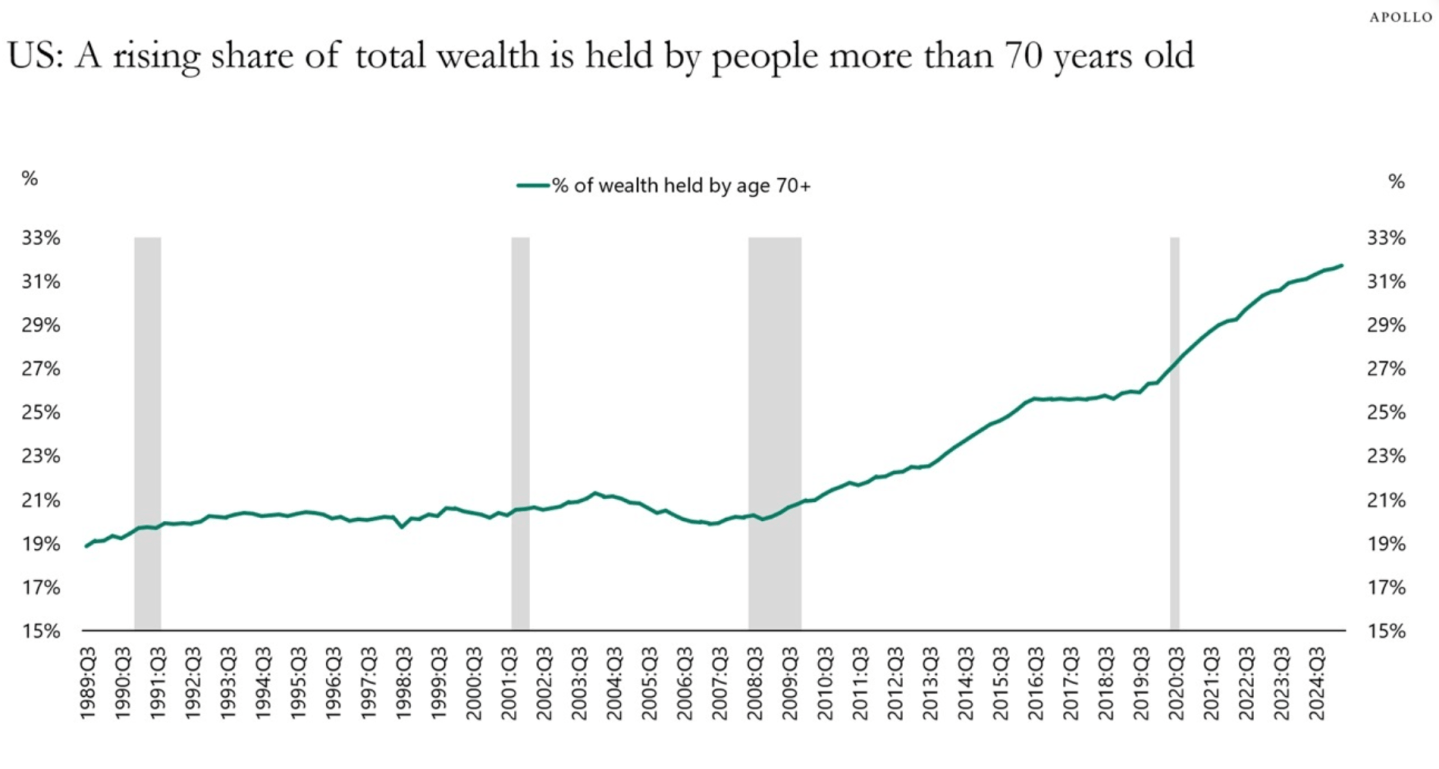
To that point, Apollo’s Slok noted in December that a record-high share of total wealth in the household sector is owned by people over 70 years old, no doubt juiced by real-estate equity.
Slok noted the changing demographics of the U.S. population, as lower birth rates and an aging population combine to slow overall population growth. The number of families with children under 18 reached a peak of around 37 million in 2007, since declining to approximately 33 million in 2024.
In an interview with Fortune, Moody’s Deputy Chief Economist Cristian deRitis said he doesn’t see the country “building our way out of this” situation. It doesn’t make sense for homebuilders to flood the market with new homes when they’re aware of the demographic picture, he argued. “Maybe for the younger generations, there will be enough homes, and we’ll see maybe a little bit of a shift here, but for the late 30-year-olds, or early 40-year-olds, I don’t know that it changes all that much.” Even with more supply in five years’ time, he added, this cohort of elder millennials will probably be locked into whatever housing arrangement they have now.
“I don’t see us solving this problem in a very dramatic way, where suddenly we build a lot of homes like we did after World War II, and all of a sudden we have, you know, all these new households being formed,” deRitis said. “I think it’s much more gradual.” This confluence of factors is combining to make America “a little bit more European,” he said, at least with regards to housing composition.
Why interest and mortgage rates refuse to budge (much)
Even with the president’s intervention pushing rates down to the high-5% range, Morgan Stanley argued, current homeowners have little financial incentive to sell their homes and finance a new purchase at a higher rate. Consequently, Morgan Stanley expects the impact on housing supply to be negligible. “While affordability might be improved for the marginal buyer, it won’t necessarily ‘unlock’ substantial additional supply to be purchased,” the analysts wrote.
Shortly before December, Slok warned that the outlook for interest (and thereby mortgage) rates coming down is diminishing. “Fiscal and inflation worries are putting upward pressure on long-term interest rates across the G3 [The U.S., Germany and Japan], and these concerns are not going away anytime soon,” he wrote in his Daily Spark column. “Rates higher for longer continues.”
As a result of the GSE purchase program, Morgan Stanley lowered its year-end 2026 mortgage rate forecast only slightly, from 5.75% to 5.6%. The firm also noted that this change would push their forecast for existing home sales up only “fractionally,” while leaving their prediction for annual home price appreciation unchanged at 2%.
Apollo’s housing outlook, for its part, bluntly said that home buying conditions are “not good,” with demand slowing because of high home prices, high mortgage rates and declining immigration. While housing supply is steady because the lock-in effect makes existing homeowners reluctant to sell their homes, and housing supply of new homes is rising, “the bottom line is that falling demand and rising supply are putting downward pressure on home prices.”
Institutional bans and future levers
Morgan Stanley was even more dismissive of the administration’s potential ban on large institutional investors purchasing single-family homes, concluding that such a ban would not have a significant impact on home prices. Institutional investors “simply do not own enough homes” to sway the market. Anyway, they have largely been reducing their holdings recently.
Sean Dobson, the chief executive for The Amherst Group, one of the largest of those aforementioned institutional investors, told Fortune in January that it was simply “inaccurate” to blame institutional ownership for housing-market affordability problems. “[It] gets both the problem and the solution wrong,” he said, blaming the current affordability crisis on “years of policy failure, not the families who rent or the capital that houses them.”
At the ResiDay conference in November, Dobson argued that these policy failures had “probably made housing unaffordable for a whole generation of Americans.” He told Fortune on the conference sidelines that many people in America feel like they’ve done everything right and “then they didn’t get what they were promised” in terms of housing. He told ResiClub’s Lance Lambert onstage that Amherst’s own analytics show that “you can only reach affordability one of three ways: by changing the price of the home, the price of the money, or the income of the family.” This means home prices would have to fall by roughly a third, interest rates fall to 4.6%, or buyer income shoot up by 55%. No quick fix, in other words.
No silver bullet
Looking ahead, the Morgan Stanley analysts outlined other levers the government could pull to lower rates further. The GSEs could reduce the fees charged to guarantee principal and interest. Regulators also could reduce risk weights on conventional mortgages to increase bank demand. Meanwhile, new Federal Reserve board members might move to stop mortgage bond run-off. Combined, these actions could lower mortgage rates by another 50 basis points, Morgan Stanley estimated. Returning to the 4% range common in the 2010s, though, would be effectively impossible through GSE actions alone; such a shift “would require a move in Treasury rates.”
The report underscores that the housing market’s challenges are structural. While the Federal Reserve has cut benchmark rates by 75 basis points since September 2025, mortgage rates have only declined by a total of 20 basis points over that period.
Inventory dynamics are also shifting unexpectedly. New housing inventory is at its highest level since 2007, driving prices for new homes below those of existing homes. Yet, with 65% of U.S. households exposed to housing prices as an asset, policymakers face a delicate balancing act. As the report concludes, “Affordability in U.S. housing is a tricky issue that lacks a silver bullet.”
Real Estateaffordability,Housing,mortgage rates,White House#Arrow #Button #Icon1769345956

