

 wellnessfitpro
Good morning. Citi’s fourth-quarter 2025 results marked a profitable close to 2025 and a turning point in its leadership, as longtime CFO Mark Mason prepares to hand the reins to his successor amid solid earnings and an ongoing restructuring.
The bank reported Q4 net income of $2.5 billion, or $1.19 per diluted share, on $19.9 billion of revenue, down from $2.9 billion, or $1.34 per share, on $19.5 billion a year earlier. On a reported basis (including a Russia-related notable item), EPS of $1.19 and revenue of $19.9 billion topped FactSet estimates of $1.02 and $19.6 billion. On an adjusted basis (excluding the notable item), EPS was $1.81 on $21.0 billion of revenue, ahead of consensus EPS of $1.65 and revenue of $20.9 billion.
“We ended the year in a position of strength, having executed against our strategic priorities,” Citi CFO Mark Mason said on Wednesday morning in his final quarterly media call as finance chief. The bank announced in November that he will step down in early March. Mason, who joined Citi in 2001 and became CFO in 2019, takes over as executive vice chairman and senior executive advisor to chairwoman and CEO Jane Fraser, while Gonzalo Luchetti, head of U.S. personal banking, will succeed him as CFO. I previously reported that his long-term ambition is to become a CEO, according to people familiar with the matter.
Mason said Luchetti has driven 13 consecutive quarters of positive operating leverage in U.S. personal banking, including returns of more than 14% in the fourth quarter and more than 13% for the full year. “I think he is well equipped and armed to come in as our newly appointed CFO and continue the momentum,” he said.
Citi said late last year it would move its retail bank into the wealth business, with the two card businesses run together under Pam Habner. Over the balance of 2026, Mason said he will help with Citi’s May 7 investor day and other strategic initiatives.
Citi is working toward a previously discussed reduction of about 20,000 roles. “We’ve made progress on that since 2022 and 2023, landing in the end of 2025 at 226,000 employees,” Mason said, adding he expects headcount to continue to trend down as productivity improves and tools like AI are implemented. It has been reported that Citi is poised to eliminate about 1,000 positions this week, following earlier rounds of layoffs.
On the economy, Mason said the health of the consumer, overall, has remained resilient. Citi’s largely prime (about 85%) card customer base is showing solid financial discipline, with spending up 5% year over year, but lower‑FICO consumers are feeling more pressure from inflation and higher prices, he explained.
As big banks report earnings, President Donald Trump’s proposal to cap credit card interest rates at 10% has surfaced as a key topic. Mason said there is not yet enough detail to speculate, but he called affordability an important issue and said Citi looks forward to working with the administration on a constructive solution.
“I also say that an interest rate cap is not something that we would or could support,” he said, arguing it would restrict access to credit for those who need it most and have “a deleterious impact on the economy.”
Sheryl Estrada
sheryl.estrada@fortune.com
Leaderboard
Fortune 500 Power Moves
Dennis K. Cinelli was appointed CFO of Paramount, a Skydance Corporation (No. 147), effective Jan. 15, and as such has resigned his board of directors seat. Cinelli will succeed Andrew C. Warren, who has served as EVP and interim CFO since June 2025. Most recently, Cinelli served as CFO of Scale AI. He previously held senior finance and operational roles at Uber, including global head of strategic finance, and later running the U.S. and Canada Mobility (Rides) business. Before Uber, Cinelli was with G.E. Ventures as CFO.
Every Friday morning, the weekly Fortune 500 Power Moves column tracks Fortune 500 company C-suite shifts—see the most recent edition.
More notable moves:
Deborah Ricci was appointed EVP and CFO of Acentra Health, a technology and health solutions company. Ricci joins Acentra Health from Guidehouse Inc., where she most recently served as partner and chief financial and administrative officer. Earlier in her career, Ricci held multiple senior finance leadership roles, including CFO positions at Constellis, Centerra Group, and A-T Solutions, and began her career as a certified public accountant with KPMG.
Rohan Ranadive was appointed managing director and CFO of GTCR, a private equity firm. Ranadive succeeds Anna May Trala, who is retiring. Trala will remain affiliated with the firm, serving as a senior advisor going forward. Ranadive brings more than 20 years of experience. He joins GTCR from Vista Equity Partners, where he was a managing director of finance operations. Before that, he was the CFO of Aviditi Advisors and spent 12 years at TPG Capital in various finance and accounting leadership roles.
Big Deal
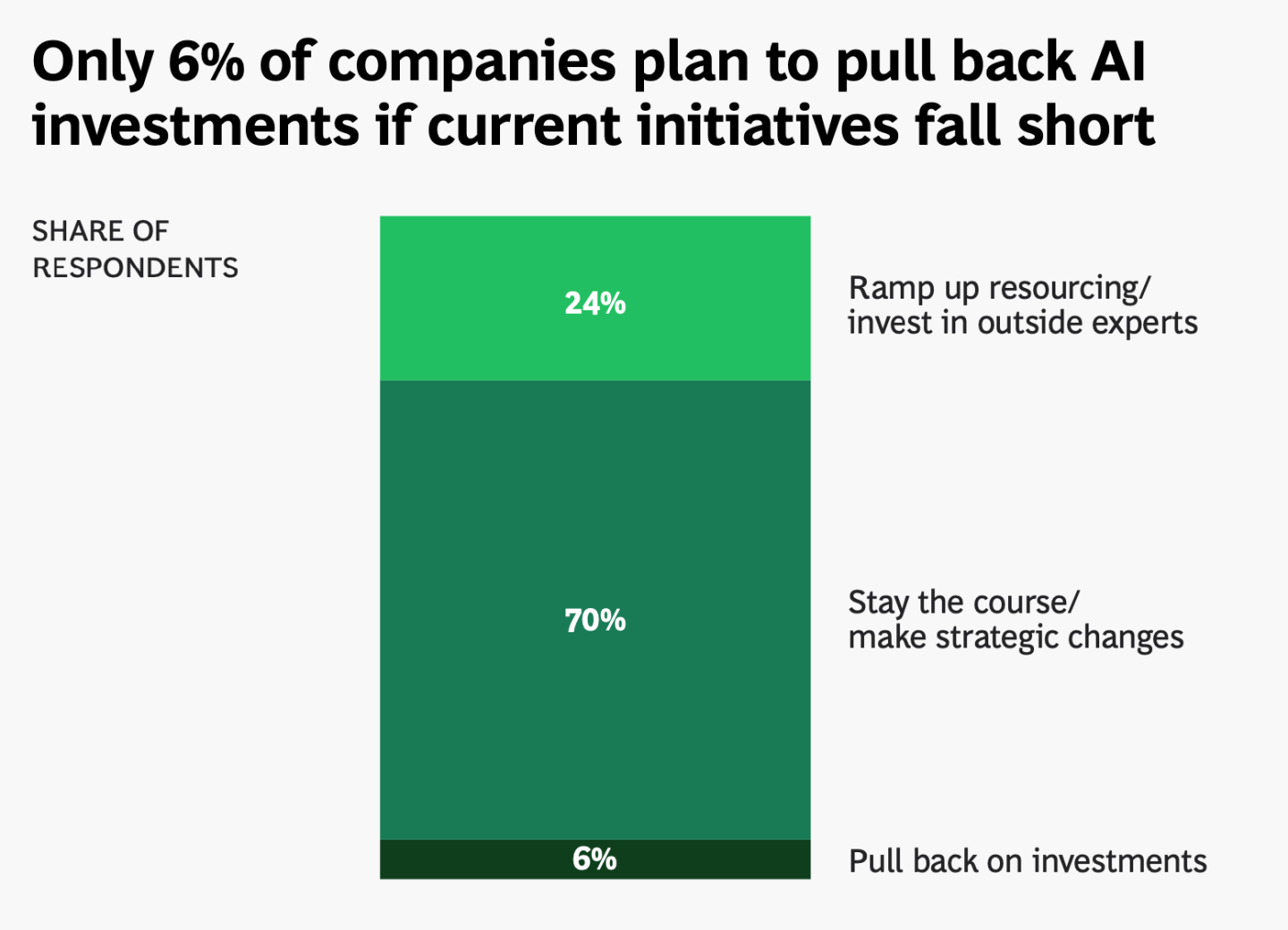
BCG’s AI Radar 2026 global survey, released this morning, finds that CEOs are recognizing that AI is more than a technology; it can fundamentally change how organizations are run.
For example, 94% of CEOs surveyed said they will continue to invest even if AI does not pay off in 2026. CEOs also said they are increasingly hands-on in AI-driven corporate transformation, with 72% saying they are the main decision maker on AI in their organization. Three CEO archetypes emerge, with “trailblazer CEOs” leading end-to-end AI transformation; 60% of trailblazers’ AI budgets will be spent on agentic AI.
“With AI spending set to ramp up further this year, the focus is shifting from ‘how much do we invest?’ to ‘how do we turn bigger AI budgets into real business impact?’” said Vlad Lukic, global leader for AI at Scale at BCG. “The stakes are rising for leadership, as capital alone is not enough without a clear strategy and disciplined execution.”
The findings are based on a global survey of 2,360 executives, including 640 CEOs, across industries at companies earning between at least $100 million and more than $5 billion in annual revenue.
Going deeper
“Can Saks’ new CEO repair the damage done to the luxury retailer by years of being treated as a ‘financial plaything’?” is a Fortune article by Phil Wahba.
Wahba writes: “For the second time in his career, luxury executive Geoffroy van Raemdonck has been tasked with fixing an iconic department store company brought low by financial engineering. In 2018, he was hired to fix Neiman Marcus Group, which was struggling to to keep up with shifting consumer trends and unprofitable under the weight of heavy debt from years of private equity ownership. This time, the job is twice as big. On Tuesday, Van Raemdonck was appointed CEO of Saks Global, the same day as the luxury department store giant, which includes Neiman Marcus Group (and its Bergdorf Goodman division) and Saks Fifth Avenue, filed for Chapter 11 bankruptcy protection.” Read the complete article here.
Overheard
“I’m optimistic that AI won’t hollow out the industrial workforce. In fact, incorporating AI at scale to support a younger workforce may be the only way to sustain it.”
—Kriti Sharma, CEO of IFS Nexus Black, writes in a Fortune opinion piece titled, “AI will infiltrate the industrial workforce in 2026—let’s apply it to training the next generation, not replacing them.”
BusinessCEOs, CFOs, CFO, CEO, chief financial officer, finance chief, chief financial officers, Kickstarter, Kickstarter's new finance chief is ultra-extroverted—and she credits that trait to her success as a people-centric CFO, Sindy Wilson, Everette Taylor, people-centric, people, talent, tech company
#Arrow #Button #Icon1768488068

