

 wellnessfitpro
The Army also imagined hundreds of miles of rail lines buried inside Greenland’s ice sheet. On Project Iceworm’s tracks, atomic-powered trains would move nuclear-tipped missiles in snow tunnels between hidden launch stations – a shell game covering an area about the size of Alabama.
In the end, Project Iceworm never got beyond a 1,300-foot (400-meter) tunnel the Army excavated at Camp Century. The soft snow and ice, constantly moving, buckled that track as the tunnel walls closed in. In the early 1960s, first the White House, and then NATO, rejected Project Iceworm.
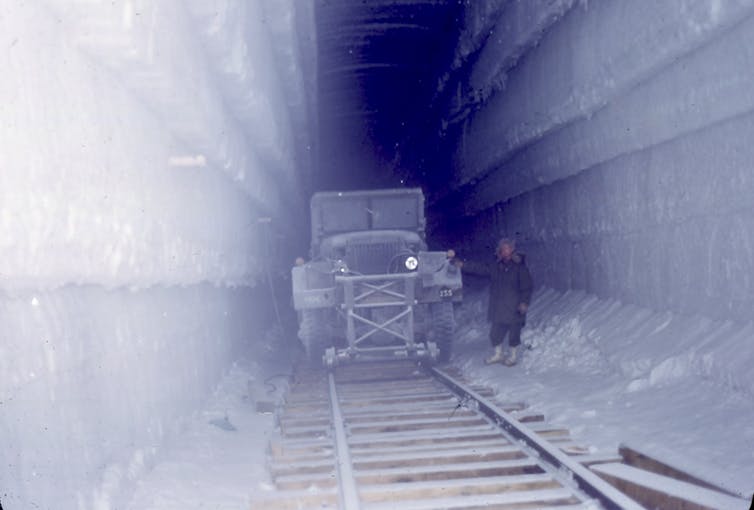
In 1966, the Army abandoned Camp Century, leaving hundreds of tons of waste inside the ice sheet. Today, the crushed and abandoned camp lies more than 100 feet (30 meters) below the ice sheet surface. But as the climate warms and the ice melts, that waste will resurface: millions of gallons of frozen sewage, asbestos-wrapped pipes, toxic lead paint and carcinogenic PCBs.
Who will clean up the mess and at what cost is an open question.
Greenland remains a tough place to turn a profit
In the past, the American focus in Greenland was on short-term gains with little regard for the future. Abandoned bases, scattered around the island today and in need of cleanup, are one example. Peary’s disregard of the lives of local Greenlanders is another.
History shows that many of the fanciful ideas for Greenland failed because they showed little consideration of the island’s isolation, harsh climate and dynamic ice sheet.
Trump’s demands for American control of the island as a source of wealth and U.S. security are similarly shortsighted. In today’s rapidly warming climate, disregarding the dramatic effects of climate change in Greenland can doom projects to failure as Arctic temperatures climb. Recent floods, fed by Greenland’s melting ice sheet, have swept away bridges that had stood for half a century. The permafrost that underlies the island is rapidly thawing and destabilizing infrastructure, including the critical radar installation and runway at Thule, renamed Pituffik Space Base in 2022. The island’s mountain sides are crashing into the sea as the ice holding them together melts. The U.S. and Denmark have conducted geological surveys in Greenland and pinpointed deposits of critical minerals along the rocky, exposed coasts. However, most of the mining so far has been limited to cryolite and some small-scale extraction of lead, iron, copper and zinc. Today, only one small mine extracting the mineral anorthosite, which is useful for its aluminum and silica, is running. The greatest value of Greenland for humanity is not its strategic location or potential mineral resources, but its ice. A NASA animation of satellite data shows Greenland’s ice sheet mass losses between 2002 and 2023, measured in meters of water equivalent in the ice. If human activities continue to heat the planet, melting Greenland’s ice sheet, sea level will rise until the ice is gone. Losing even part of the ice sheet, which holds enough water to raise global sea level 24 feet in all, would have disastrous effects for coastal cities and island nations around the world. That’s big-time global insecurity. The most forward-looking strategy is to protect Greenland’s ice sheet rather than plundering a remote Arctic island while ramping up fossil fuel production and accelerating climate change around the world. Paul Bierman, Professor of Natural Resources and Environmental Science, University of Vermont This article is republished from The Conversation under a Creative Commons license. Read the original article.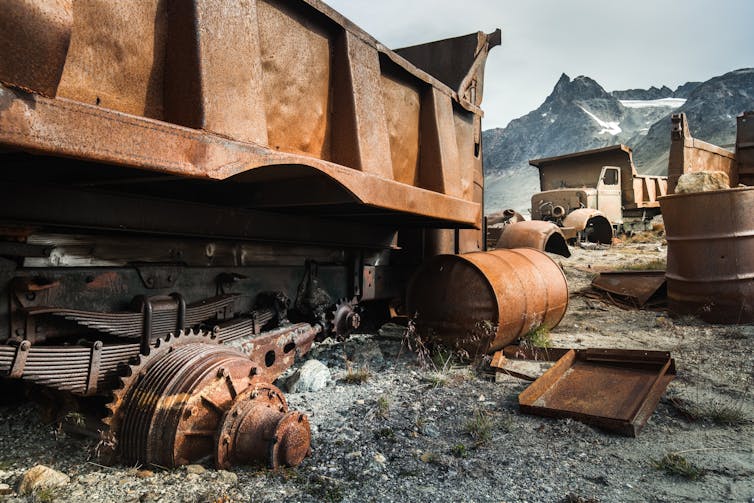
It’s the ice that matters

EuropeGreenland#Americans #quietly #plundering #Greenland #years #Navy #officer #chipped #fragments #Cape #York #iron #meteorite1768447625

